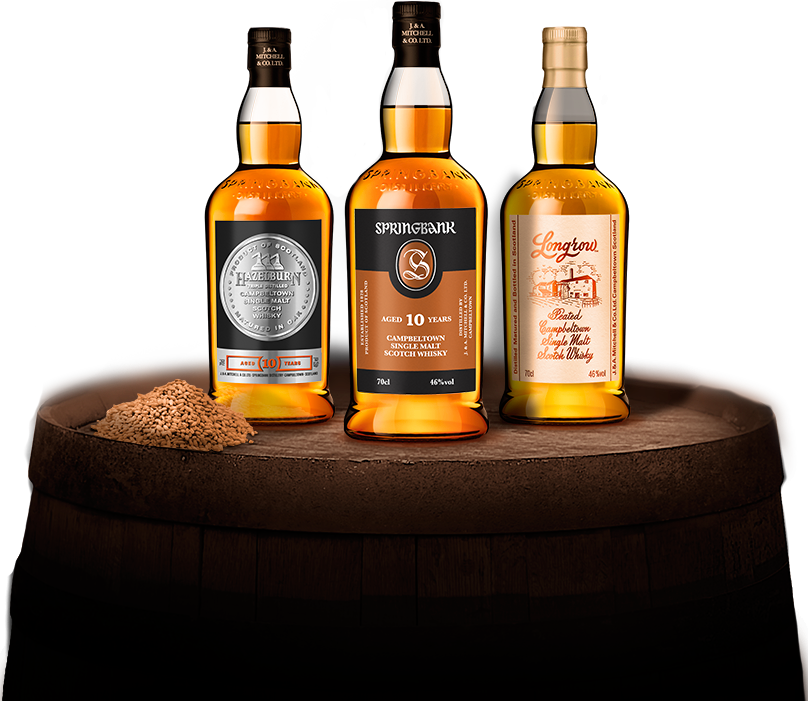
Springbank
Longrow
Kilkerran
Hazelburn
Springbank Society
Tasting Room
 
SPRINGBANK WHISKY DISTILLERS
THE MAKING OF SPRINGBANK WHISKY

It is a fact that no distillery in Scotland is as self-contained as Springbank. From the actual malting of the barley, the very first step of the whisky-making process, through to the final one of bottling - even occasionally at natural cask strength - every detail is carried out on site under the experienced and exacting gaze of Springbank staff, led by the distillery manager.

Very few distilleries these days malt their own barley using traditional floor maltings. Springbank is one of only a handful dotted around Scotland keeping the tradition alive.

But here again, as in so many other ways, Springbank is unique. It is one of only two distilleries which malt all the barley required for distilling, which means Springbank has greater control over its quality than most other distilleries in Scotland.

On arrival at the distillery the barley is first conveyed into the barley loft and stored. When required it is steeped in cool, clear water. During this period of soaking the barley swells and then after two or three days it is then laid out in a six inch deep even layer on the maltings floor.

With the aid of shovels called shiels, made from wood to protect the grains from damage, the barley is turned at regular intervals.

Slowly, germination begins: the starch in the grains turns to sugar and little rootlets begin to sprout from the barley. After nearly a week this growth is stopped by a subtle drying process.

The green malt, now laden with natural sugars from which alcohol will be produced is removed into a kiln. During the kilning process, the malt is initially dried over a peat fire, using locally cut peat, followed by a longer drying period over hot air.

After about 26 hours of kilning the green malt is now dried malt; crisp to bite and, because of the sugars, sweet to taste. It is then ready for milling where the malt is crushed into a fine powder called the grist and the rootlets are removed.

Just like tea, the grist is then added to hot water to extract all the flavours and sugars into the liquid. This is called mashing, a process carried out in a large round vessel called the mash tun with stirring devices known as the rakes. In Springbank's case this equipment is made of cast iron and dates back nearly a century. This process is carried out three times with each grist, and the liquid taken from the final draining is then added to the liquor used for the first water of the next mash.

Water of outstanding quality is vital in the whisky making art. Springbank for the last century, at least, has drawn its own from a source just south of Campbeltown, Crosshill Loch, which in turn is fed by springs seeping from the northern slopes of 1155 foot high Beinn Ghuilean, close to Tomaig Glen. This pure spring water will have reached the surface after having fallen in the area decades earlier as rain or snow and sunk into the ground. Now, at the distillery it has three purposes, the last of which we shall see later. But first it is used for steeping the barley, and then it becomes the boiling liquor into which the sugars from the malt are dissolved during the mashing process.

The resulting liquid, known as wort, is transferred to even larger wooden vessels called wash backs. At Springbank there are six of them, each made from boatskin larch. It is here the yeast is added, which eventually converts the sugars into alcohol. The interaction between the yeast and the sugar is a violent one; the liquid froths and large amounts of carbon dioxide are emitted.

Finally, after an unhurried 70 hours fermentation, one of the slowest anywhere in Scotland, the wash, as it is now called, has calmed into a gently bubbling yellow-brown beer-like liquid and is ready for distillation.

All Scotch malt whisky is produced in large onion-shaped copper pot stills which are the proud centrepiece of any distillery. From distillery to distillery they vary in height and squatness and the shape of the still adds to the individual character of the distillery's whisky. They do, however, all work to the same fundamental distilling principles.

But even here Springbank takes an individual approach.

Instead of using the conventional double distillation method, Springbank boasts three stills and operates a form of partial triple distillation. The wash is pumped into a wash still where the liquid is boiled. The resulting distillate produced, called low wines, is transferred to the low wines still, where it is boiled a second time. The product of this distillation, called feints, is then transferred to the spirit still, from which the sprit "cut" is collected.

At Springbank the wash still is fired from the bottom by live flame and the spirit stills are heated by steam coils from inside. It is thought Springbank is the only distillery in Scotland to do this. Most distilleries these days use only the coils. To save solids within the wash burning at the bottom of the wash still, it is fitted on the inside with copper chains, called rummagers, which rotate on an arm.

The method of continuously scraping solids including yeast and barley has always been considered an important factor in the whisky's eventual character. When other distilleries switched from direct flame heating to solely steam coil heating in the 1960s, 70s and 80s many managers reported a change in the character of their spirit, and rarely for the better.

Because the boiling point of alcohol is lower than water, it is the alcohols which evaporate first, driven up the neck of the still into a copper coil called the worm surrounded by cool water. Here the vapour condenses. The liquid spirit runs to a glass box called the spirit safe where the stillman monitors it progress.

The first alcohols called the foreshots are impure, as are the final ones called the feints. So it is the middle "cut" of the run the stillman selects.

Because of the distillation techniques employed, the whisky should be lighter in character than most, but Springbank and theory have never travelled hand in hand. New make Springbank, that is the colourless spirit which runs from the still, is both clean tasting yet as complex on the palate as any made in Scotland. And it is a complexity which intensifies with time to make Springbank whisky one of the most sought after and savoured drams among connoisseurs.


Ageing, Character, Warehousing and Stocks

The reasons why Scotch malt whisky is by far and away the most complex of all spirits are legion, and, to a degree, still to be understood.

We have already looked at how water, barley, peat and copper stills each play their own unique part in the development of Springbank whisky. But, almost certainly, it is what happens after the spirit has been run off the still that determines the final outcome of how it will nose, how it will taste on the palate and in the finish which lies on the tastebuds several minutes after you have swallowed.

It has only been in recent years that the whisky industry in general has fully appreciated the significance of the quality of the wood used to store the whisky and the part it plays in character development. But the importance of the wood selected has been a vital factor in the making of whisky at Springbank distillery since the turn of the century.

After the spirit has been filled into an empty cask it is left in a dark, moist warehouse from anything from three years (the age when the spirit legally becomes whisky) to 30 years before it is taken out to be bottled. Sometimes Springbank can be aged for even longer and in 1969 the distillery bottled a delightful whisky from casks which had been filled in 1919.

The weather in this south-eastern corner of the Kintyre peninsula is altogether different, and it is location and weather, together with the type of wood used, that have the final say in the fashioning of a whisky.

Once Springbank is casked beyond eight years of age a particular salty trait can be detected. It begins with the merest hint, but as the whisky matures the briny tang appears to intensify: never too strong, just as salt is used on a meal it somehow manages to help bring out and highlight the other countless flavours within the spirit.

It is easy to understand that this salty, fresh trademark of SpringbankÕs has to do with its coastal location and the strong perennial winds which blow the moist sea air, warmed by the Gulf Stream, into the draughty warehouses: the older the whisky the more powerful the coastal assertiveness on the taste becomes.

In the bottling process, Springbank is one of the last distillers to refuse to add caramel to its whisky for colour uniformity. And it is sometimes interesting to see the difference in the hue of whisky within the bottles. Occasionally, one bottle of Springbank is lighter than another of the same age but that does not mean it is of inferior quality. There will certainly be subtle differences in the taste of the whisky, however, and it is up to the individual to decide which style he or she prefers.

Whisky matured in former bourbon casks will be lighter in colour and body than those matured in former sherry casks.

By contrast, whisky matured in former sherry casks will early on be affected both in taste and colour by the sherry itself which has seeped into the oak. Only in later years does some of the wood character also transfer to the whisky.

To keep in all the subtleties and secrets of Springbank whisky, the spirit is one of the very few not to be chill-filtered before bottling. (By chill-filtering a natural hazing of the whisky at low temperatures is avoided).

But by chill-filtering, some of the vital congeners carrying the whisky's flavour are also lost. So Springbank bottle their whisky at 46% alcohol by volume, rather than 40%, to prevent hazing yet to retain the very essence of the spirit.

This is why choosing a Springbank is like choosing no other single malt: it is a most personal act. Its nuances must be understood, but to do that you have to sample Springbank at many different ages and colour tones. It is this which makes Springbank the most complex and exciting of all malt whiskies.